What Organizers Must Build Into Registration Flow so Debaters Arrive Knowing Every Scoring Criterion and Their Appeal Rights
Registration can make scoring and appeal rules unmissable.

Registration is where debate organizers can make scoring criteria and appeal rights part of entry, rather than information competitors are expected to find later. Treating that flow as a transparency checkpoint gives every entrant access to the standards governing preparation, performance, and review before the first round begins. That is both a procedural safeguard and a condition for useful learning.
Why registration is the last guaranteed moment of shared attention between organizers and competitors
Registration systems are designed to collect names, entry fees, and judge obligations, but they could also establish that competitors have encountered the rules governing their participation. Rule awareness is treated as a separate responsibility. That separation is a design choice.
The distinction is important because registration is the one procedural gate every entrant must pass through. Coach emails, handbook PDFs, and pre-tournament briefings reach competitors unevenly, even when they contain the necessary information. Their availability does not establish that every debater received them. Registration is the last point when organizers can count on having every competitor’s attention and show them the standards that apply.
A competitor who has read the rubric can prepare with it in mind, while another may prepare by guessing what judges reward. Neither entry information nor payment resolves that difference. If registration confirms only administrative readiness, it leaves informed participation to channels that do not reach everyone equally.
Briefings and handbooks can explain or reinforce rules already disclosed. They cannot substitute for a common checkpoint when competitors need the information before preparing for and entering their rounds. Registration is thus the clearest chance to establish informed consent before competition begins.
What scoring criteria actually contain and why debaters cannot reconstruct them from first principles
A scoring rubric is more than a general request for persuasive argument. It defines the categories judges assess, their weights, and the evidence of performance those categories require. Those details vary by format and tournament. Familiarity with debate does not reveal which particular framework an organizer has adopted.
The Donald Dewar tournament’s judging guidance marks Content out of 60 and Style out of 40 for main speeches. For reply speeches, Content is marked out of 30 and Style out of 20. The relative proportions are the same, but the available marks differ by speech type. Disclosure must preserve that distinction rather than reduce the rubric to a verbal statement that content receives greater emphasis.
The guidance also gives Content a specific meaning. It includes relevance to the motion, the use of facts and figures to support arguments, citation of sources of authority, and visible research depth. These are preparation requirements. A debater cannot make research depth visible without knowing that the rubric asks judges to assess it.
Advancement introduces another layer that cannot be inferred from individual speech scores. The KSHSAA 2026-27 Debate Manual places truncated preliminary round ranks, with lower ranks preferred, before reciprocals of ranks in its advancement order. Speaker points are not listed as a primary criterion. A competitor who assumes that a marginal point determines advancement is reasoning from the wrong formula.
The boundary of review is equally specific. The review rules described here do not allow review bodies to interpret judges’ written comments or reconsider point deductions. Misapplication, misinterpretation, or disregard of a stated rule is reviewable, while a judgment call is not. Disclosure must distinguish the scoring framework from the narrower grounds on which its application can be challenged.
How appeal windows work in practice and why their logic must reach debaters before the round, not after
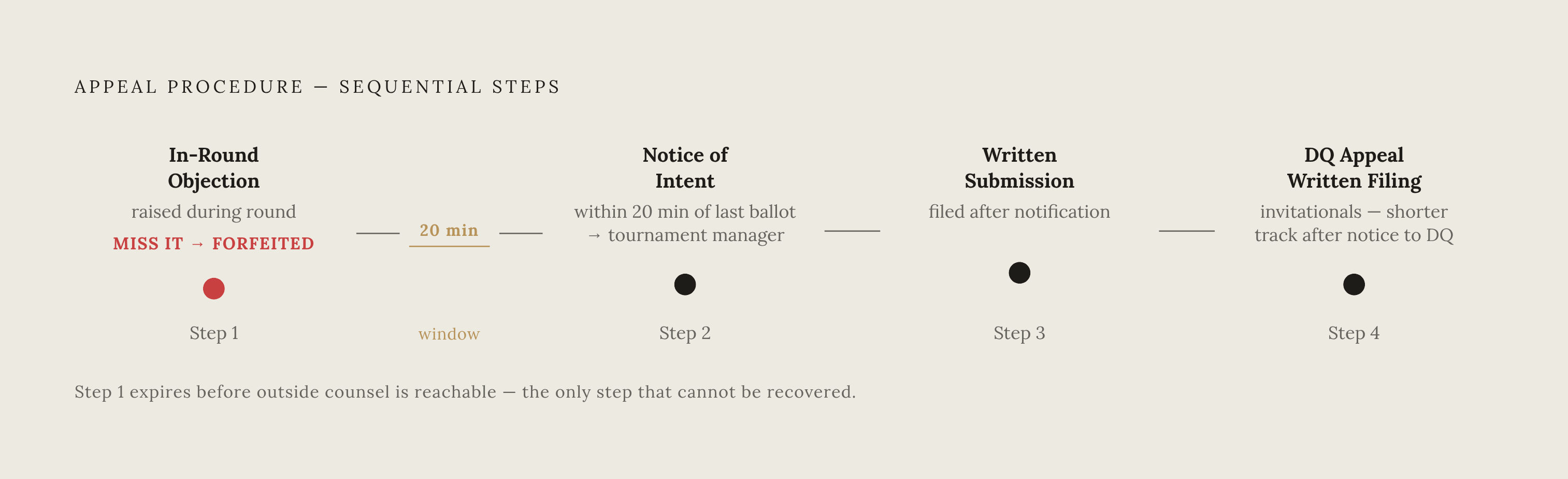
Knowing the rubric is only part of what a competitor needs to be able to challenge a rule error. Appeal rights also depend on procedural steps taken at the right time. Where a ruling must have been challenged in-round, failing to raise the issue forfeits the later appeal.
A debater may still have time to contact a coach or reach the tab room, yet no longer have a reviewable claim because the required objection was never made. The missing step cannot be supplied retrospectively. Knowing the rules before the round helps competitors get relief as well as making the work easier for tournament staff.
KSHSAA’s manual and the UHSAA 2026-27 Handbook both provide a 20-minute period for notice of intent to appeal, beginning once the last ballot has been collected. The notification route differs between them. KSHSAA directs notice to the tournament manager, while UHSAA directs it to the tabulation committee. Competitors need the route that applies to their tournament, rather than a generic instruction to seek help afterward.
The written submission must then follow shortly after notification. Disqualification appeals at invitationals operate on a shorter track, with the written appeal due shortly after notification to disqualify. These are compressed procedures. Knowing the order of objection, notification, and written submission helps competitors meet each prerequisite in time.
Registration is the point at which that sequence can reach every entrant before any prerequisite expires. A policy delivered after the round may explain why relief is unavailable without enabling a competitor to obtain it. By contrast, advance disclosure makes the in-round obligation intelligible when action is still possible. Appeal rights become usable only when their conditions are known in time.
What registration materials must affirmatively include to close the knowledge gap
Closing this gap requires structured disclosure and confirmed acknowledgment. The registration flow should present the full scoring rubric for each event entered, including its weights. A general handbook link is not equivalent. The competitor needs the framework for the format in which that entry will compete.
The advancement formula belongs with that rubric because scoring and advancement answer different questions. Registration materials should say whether preliminary advancement is rank-based and list the tie-breaking order. Without that distinction, competitors may know how a speech earns marks but misunderstand how the results decide who advances. Both frameworks shape preparation and competitive decisions.
Appeal disclosure should then connect the grounds for review to the actions required to preserve them. It needs to explain that judgment calls are not appealable and that a challenged ruling must have been raised in-round. Timing must be expressed as an operative countdown. KSHSAA, UHSAA, WISDAA, and CHSAA specify notice of intent to appeal within 20 minutes of the end of the debate round, with the applicable rules defining the trigger and notification route.
The tournament’s AI use policy also belongs here. The ASDA 2025-2026 Handbook covers what AI use is permitted, what citations are required, the need for a credibility statement, and the rules on accountability. These conditions affect scoring and eligibility from round one. Competitors need these conditions when they enter, even when the rules cover work done before they arrive.
How these disclosures are shared decides whether competitors must read them during registration or can skip them. A checkbox stating “I have read the rules” does not establish that the debater encountered the specific criteria. A required scroll-through or question-gated acknowledgment addresses that narrower problem more directly. Neither should be confused with proof of complete understanding, but each makes engagement with the disclosed material part of the flow.
UHSAA’s handbook requires ballots to include a warranted reason for decision. That requirement benefits competitors who already understand the standards a reason should address and the limits of any challenge. Registration disclosure supplies the context for reading the ballot. It connects what judges must explain with what debaters can properly contest.
How AI judging changes the disclosure obligation and what transparency looks like in that context
Competitors still need the rubric, the advancement formula, and the appeal procedure, but they also need to understand how the system applies its criteria. Organizers must explain that the system has no human discretion. A competitor should not have to discover the system’s scoring logic or limitations through an unfavorable result.
The fairness argument for AI judging rests on stated criteria and consistent application. It proposes that the same logic governs every competitor and that results do not depend on undisclosed personal preferences. That argument depends in part on competitors seeing and understanding the scoring framework before the round.
For a system assessing logic, evidence quality, rebuttal effectiveness, and persuasion, those dimensions define what the decision is intended to evaluate. Naming them in advance gives competitors a basis for interpreting the eventual reasoning. A readable decision alone is not enough. Without prior disclosure, it may reveal the standards for the first time instead of explaining performance against known standards.
System errors require a further distinction. Hallucinated citations, misattributed arguments, and errors in evidence evaluation are not simply equivalents of a human judge’s judgment call. Registration materials should explain the appeal path when the alleged error originates in the system. Otherwise, a general statement that judgment calls are non-appealable may leave competitors unable to understand whether a system failure can be reviewed.
Transparency in this setting can include publication of scoring rubrics before any round begins, independent panels of AI judges scoring separately, and decisions that cite what was actually said. The rubric exposes the standard, separate scoring makes the judging structure visible, and citations connect the decision to the debate. These features do not eliminate the need to disclose limitations or review rights.
The governing principle remains the same for human and automated judging. Competitors need to know what will be assessed, how the decision will be explained, and what kinds of error can be challenged. Automation makes those questions more explicit. It does not justify leaving any of them until after the first result.
Why building this into registration produces better debates, not just better-informed competitors
Sharing the standards in advance changes how competitors prepare by giving them clear criteria they can learn and work toward. Knowing that Content includes relevance, evidence, citation of authority, and research depth directs attention to those features before a speech is delivered. The objective becomes more precise than winning the room. Preparation can be assessed against the same categories that will later organize feedback.
Knowledge of appeal rights supports a different form of precision. A debater who understands that rule misapplications can be appealed and judgment calls cannot can frame an in-round objection around the applicable rule. That is a skill exercised under procedural constraints. It cannot be practiced effectively if the competitor learns the prerequisite only after the chance to object has passed.
The Donald Dewar guidance frames debate as developing analysis, research, logical structure, rebuttal, and confidence. Those skills grow with repeated use, while learning the basic assessment rules after each attempt takes time away from that practice. Early rounds have educational value of their own. A competitor who spends them uncovering the rubric loses opportunities to test preparation against a framework already understood.
In this way, debate practice is more like chess training than classroom discussion. It has a real opponent and a scored result, with feedback on how the competitor did in that debate. Yet the result becomes more useful when the competitor knew the assessment framework beforehand. The ballot can then confirm or challenge a preparation strategy.
Registration designed around disclosure compresses that learning curve. It makes the first round an opportunity to apply known criteria and the first ballot an opportunity to examine that application. The design expresses what organizers believe debate is for. If the purpose is skill development, every competitor arriving with knowledge of the criteria is the minimum condition for that development to begin.