How Pre-Round Rubric Disclosure Changes What Debaters Actually Argue
Knowing your judge's rubric before the round reshapes which arguments debaters choose to make.

Pre-round rubric disclosure changes debate strategy by changing both which arguments are worth making and how they are delivered. Human judge paradigms and published AI scoring criteria give debaters an evaluative frame before they speak. The strategic task is to use that frame to select arguments, build their logic, and make explicit comparisons rather than treating disclosure as advice about presentation.
What rubric disclosure actually is and how it reaches debaters before a round
A judge paradigm is a written statement of judging preferences, priorities, and sometimes explicit exclusions. Tabroom.com provides the central infrastructure through which judges enter their philosophies and competitors access them when pairings are released. The information arrives before the first speech. It therefore gives debaters time to compare a prepared case with the preferences of the judge assigned to evaluate it.
Paradigms do not all disclose the same things. Some provide numerical rankings for topicality, counterplans, kritiks, and conditionality, while others explain a judging philosophy in prose or identify positions the judge will not vote on. A ranking expresses a preference compactly. Prose can explain the conditions under which an argument becomes persuasive. The NCFCA’s Team Policy Debate Judge Helps frames judging as a process that requires judgment calls. A paradigm makes the lens behind those calls available before the round rather than leaving competitors to infer it from the decision afterward.
Why disclosed criteria change what debaters argue, not just how they deliver it
Style adjustment changes the presentation of an existing case. Argument restructuring changes the case itself. A judge who wants clear speech might change how fast a debater speaks, but one who rules out kritiks removes a branch of the case, and one who requires comparative weighing changes what rebuttals must show. Numerical rankings also show which argument types could hurt a debater’s score. These disclosures influence where a debater spends preparation time and which claims survive into the round.
UIL 2026 CX State judge Verna Lantz prioritizes explanation, support, and weighing of arguments over speed. She says she wants arguments that are well organized, strong warrants, and clear impact comparison in rebuttals. That creates a reason to consolidate arguments. Slowing down without reducing the number of claims would address delivery while leaving the deeper strategic constraint untouched. With a tab judge who is comfortable with technical argumentation, debaters may have more room to cover arguments line-by-line.
UIL 2026 CX State judge Jonathon Herrera states that arguments not clearly extended, impacted, and weighed in the final rebuttals, the 2NR and 2AR, will not enter his decision. This also shapes how debaters build the case, because they need to know how an opening claim will lead to that final comparison. The Chicago Debates 2025–2026 judge guide likewise directs judges toward argument strength, refutation, evidence-based persuasion, and comparative issue-weighing while deprioritizing presentation style. A polished speech cannot substitute for the reasoning that the disclosed criteria require.
How debaters actually read a paradigm to make strategic decisions in the minutes before a round
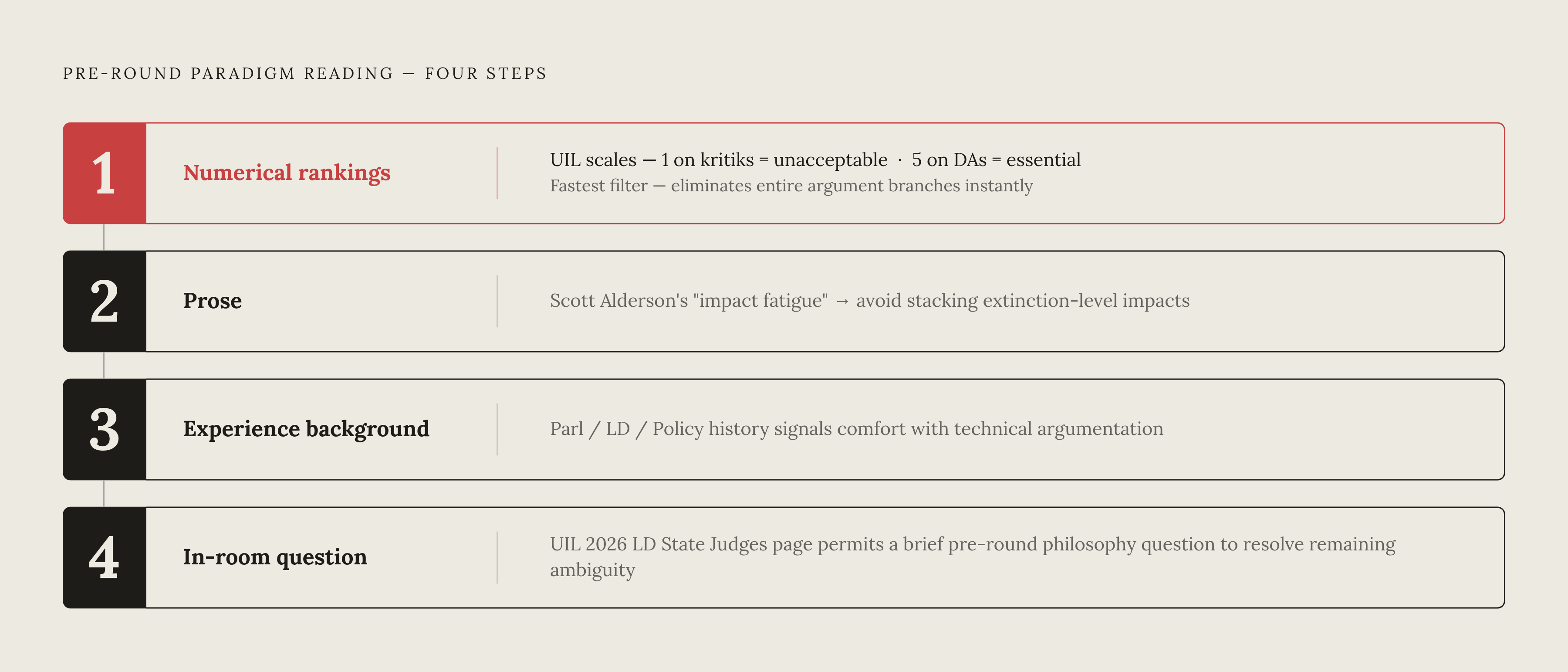
For debaters, the practical reading sequence begins with numerical rankings. UIL’s 2026 CX State judge profiles use scales that distinguish preferences across argument types, providing a fast way to identify exclusions and priorities. The labels need careful reading. A 1 on kritiks means unacceptable, while a 5 on disadvantages means essential. The same number does not express the same judgment across every category. Reading the scale correctly prevents a broad impression of technical openness from obscuring a specific restriction.
Prose comes next because it explains preferences that numbers cannot. UIL 2026 judge Scott Alderson writes, “I suffer from impact fatigue.” That signals a reason to avoid stacking extinction-level impacts and instead emphasize realistic, well-warranted harms. A debater acting on it would reconsider which consequences to defend and how much causal support each consequence needs, rather than simply describing the same speculative harm in quieter language.
Experience background is the third layer of interpretation. Experience across parliamentary, LD, and policy formats signals familiarity with technical argumentation, while an absence of listed competitive experience suggests a need for plain-language explanation and big-picture framing. Neither signal replaces an explicit statement of preference. The final step is an in-room question about unresolved ambiguity, such as speed or argument tolerance. UIL’s 2026 LD State Judges page expressly permits a brief pre-round explanation of judging philosophy, giving debaters a way to clarify what the written paradigm leaves uncertain.
The four specific argument decisions debaters restructure once they know the rubric
First, debaters decide which argument leads. The Chicago guide’s emphasis on evidence-based persuasion and comparative weighing favors the strongest warranted claim over the most provocative one. Under that frame, an opening argument earns its place through support and its usefulness in the eventual comparison. Novelty alone does not establish that usefulness.
Second, debaters decide which argument gets dropped. A judge who rates kritiks at 1 on the UIL scale identifies that argument type as unacceptable, creating a reason to remove it before the round begins. This is a constraint on what that judge is prepared to credit. The same mechanism applies when a traditional LD paradigm favors philosophical frameworks and explicitly rejects kritiks, regardless of which approach the debater considers stronger.
The third decision is how to frame the logic. A lay judge may need a big-picture account and an explicit causal chain where a technical judge would be comfortable with line-by-line refutation and compressed explanation. The adaptation changes what must be said. Premises that might remain implicit before one judge become necessary parts of the argument before another.
The fourth decision is how to weigh impacts. UIL 2026 CX judge Layne Morris states that arguments begin with equal weight until debaters explicitly distinguish them, and that he will not perform the weighing for them. The Chicago speaker points rubric reinforces this emphasis by rewarding organization of thought, strategy in extending, defending, and negating arguments, strength of main arguments, teamwork, comparative weighing, explanation of evidence, and persuasiveness. Knowing those dimensions also changes how debaters allocate speech time that they might otherwise use for improvisation.
Where rubric disclosure creates genuine trade-offs, not just advantages
Argument authenticity is the first unresolved tension. Disclosure pressures competitors to select arguments according to a particular judge’s preferences, even when they consider other arguments true or strongest. The NCFCA guide instructs judges to decide on persuasion rather than personal beliefs, but debaters still have an incentive to anticipate the preferences a paradigm reveals. Those obligations pull in different directions. A judge can aim to be fair while publishing preferences that narrow the range of cases competitors are willing to bring.
That narrowing creates a second tension around conformity. When a paradigm discourages an argument type, competitors have less reason to develop and run a compelling version of it. The judge then has fewer opportunities to reconsider that skepticism. Across a circuit, the risk is reduced argument diversity, with familiar approaches retaining their advantage partly because alternatives are filtered out before anyone hears them.
Reading the same document does not give every team the same capacity to rebuild a case between pairings and round start. Programs with coaches who can interpret a paradigm have an adaptation advantage. The NCFCA guide acknowledges that negative teams may first hear an affirmative case in the opening speech and must rely on logical assessment and generic arguments. That constraint parallels the position of teams that receive a paradigm but lack the preparation support to translate it into a tailored strategy.
The NSDA’s November 2025 update to its Judge Paradigm Standards acknowledges the tension between information and exclusion. It instructs judges not to shut down argument types or state what kinds of debate they will or will not allow. Instead, paradigms should explain what debates judges find persuasive and what arguments may help competitors receive better speaker points. The distinction preserves disclosure while discouraging outright prohibitions. It does not resolve the pressure to conform to a judge’s stated preferences.
How AI judging makes the rubric-disclosure dynamic visible in a fundamentally new way
AI judging shifts the focus from a judge’s preference statement to the rules of scoring. In a system with published criteria, dimensions such as logic, clarity, response quality, and persuasion can be defined before any argument is made. The evaluative frame becomes more explicit. Rather than inferring priorities from a judge’s background or prose, debaters can examine the dimensions against which their spoken arguments will be assessed.
For a live voice debate platform with AI judging and a published scoring rubric, the relevant distinction is between automated feedback and advance disclosure. A score given afterward tells students how the system judged what they said. Criteria published beforehand also inform the construction of that performance. That difference is central to practice. Students can choose arguments with the scoring dimensions in view and then compare the resulting assessment with the case they intended to make.
The strongest version of this model evaluates only what was said, rather than a competitor’s name, appearance, reputation, or relationship to a human judge. It promises to bring scores closer to the stated criteria. The rubric must be applied consistently for advance disclosure to function as a dependable guide, and a published description of criteria should not be confused with proof that every scoring decision follows them.
Changing the judge does not eliminate pressure to conform. An AI rubric that favors conventional structure may penalize an unconventional argument even when its reasoning is strong. Poor design or calibration can reproduce the same narrowing that human paradigms encourage. The transparency response is to publish criteria, separate the scoring dimensions, and make the rules available before the round. That makes the evaluative frame open to scrutiny without pretending that a visible rubric is necessarily an adequate one.
What debaters should do differently in the 15 minutes between pairings and round start
Use the pre-round window to turn information into decisions. Scan numerical rankings first, and read each scale’s labels before deciding which positions pose too great a risk to the score. A 1 on kritiks or conditionality is a direct signal to cut those positions under the stated UIL scales. Then read the prose for impact fatigue, pace preferences, and evidence standards. Translate each relevant signal into a change to argument selection, causal explanation, or comparative weighing.
Use the written paradigm to generate a focused question. Where a pre-round philosophy question is permitted, ask about the ambiguity that could change the case, rather than requesting information the paradigm already supplies. Settle the cuts before the first speech. Removing a speculative argument during preparation preserves the opportunity to strengthen what remains, whereas postponing that choice leaves it for a pressured rebuttal. Pre-round compression is a strategic choice that can leave out arguments of high quality.
Apply the same discipline in AI-judged practice. Read the published rubric dimensions before the live spoken round, decide which arguments best meet each criterion, and build the case accordingly. Keep the dimensions distinct during preparation. Logic requires a defensible chain of reasoning, while response quality directs attention to engagement with the opposing case, so a strong opening alone cannot serve both purposes.