Verbosity Bias and Its Effect on Debate Scoring Fairness
Longer arguments win with AI judges, even when they don't make better points.
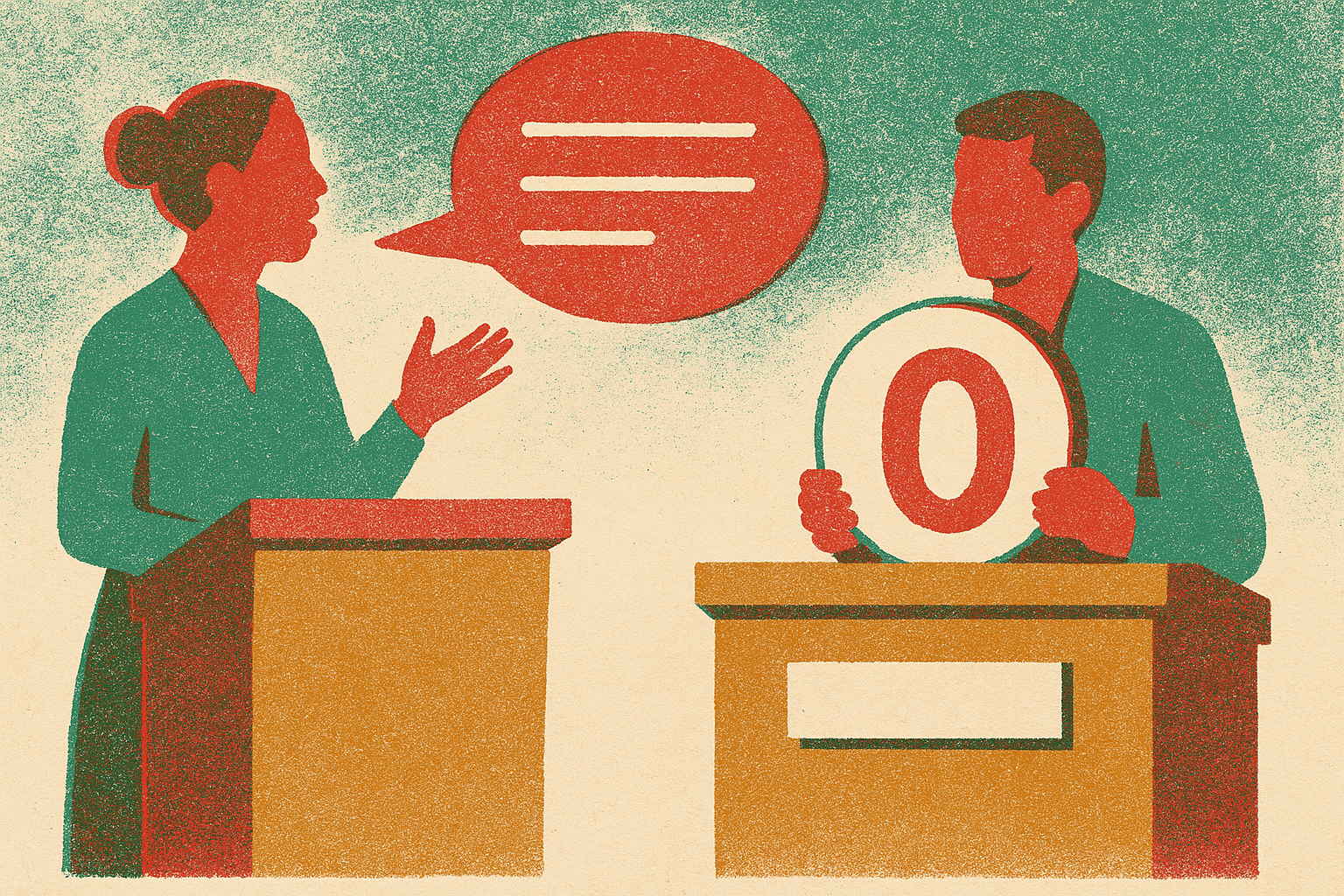
Verbosity bias is a measurable tendency in AI judges to score longer responses higher, whether or not the extra length makes the argument any better. In debate scoring, where an AI judge might decide a round, this moves from a curiosity about how language models behave to a fairness problem with a direct effect on who wins.
Why verbosity bias matters as a judging problem
Picture two debaters making the same core argument. One states it in four sentences and sits down. The other restates it five times, piles on supporting detail of uneven relevance, and runs the clock. An AI judge scoring the round on reflex, rather than on a rubric that explicitly weighs concision, will tend to reward the second debater because length itself reads as a signal of effort and thoroughness.
That reflex has a clear origin. Length correlates with thoroughness in the training data these models learn from, so the model picks up word count as a stand-in for quality. No rubric names this proxy, and no debater is ever warned about it. A human judge has the same vulnerability to a long, confident answer, but a human judge's length preference shifts from day to day, from mood to mood, from one round to the next. An AI judge's does not. It applies the same tilt in round one that it applies in round forty, consistently, across every debater who appears before it, which turns an individual quirk into a structural tilt baked into the scoring system itself.
Verbosity bias does not sit alone. Researchers studying LLM-as-judge systems have documented a cluster of related distortions: position bias (favoring whichever response appears first or last), self-preference or self-enhancement bias (a model favoring output that resembles its own style), and bandwagon bias (a judge shifting toward a position because other signals suggest it is popular). This list has not settled at some fixed number; surveys of the field keep turning up additional variants, each with its own trigger conditions. Verbosity bias belongs in that company as a documented, reproducible failure mode, not a hunch about how chatbots behave.
How verbosity bias distorts a debate round
Inside an AI-judged debate, word count becomes a lever a debater can pull that has nothing to do with the strength of the argument underneath it. Researchers studying structured debate among language models found that aggregate Elo ratings rose noticeably as argument length increased, so judges were choosing longer arguments over shorter and more accurate ones. That finding matters because it shows how hard it is to separate a judge's preference for length from its judgment of actual quality. The two get tangled together even when the people building the evaluation know to watch for it.
The habit this creates runs deeper than any single verdict. Debaters and coaching teams, once they notice which arguments get rewarded, start padding their speeches rather than sharpening them, whether or not anyone decides to do so deliberately. So the bias no longer stays a scoring error in isolated rounds; it trains behavior across an entire season of practice.
A 2025 EMNLP benchmark on long-form debate speeches adds a sharper edge to this picture. It found that even the strongest LLM judges diverge from how human judges actually score debate, and that these strong judges rated speeches generated by GPT-4.1 above speeches delivered by human expert debaters. That result raises an uncomfortable question: are LLM judges responding to stylistic patterns they recognize as machine-generated, independent of any stated rubric? If so, a judge responds to a style it has learned to associate with competence, a preference operating underneath the rubric rather than inside it, so the bias is about more than counting words.
None of this is unique to machines. Competitive policy debate has wrestled with an almost identical failure mode for decades in the form of "spreading," the practice of delivering arguments at extreme speed to cram in more content than an opponent can answer. A 2026 UIL State judge put the objection this way: "Debate is a communication event and a monotonous flow of words punctuated with gasps of breath is not effective communication. The preference for volume over clarity did not arrive with AI judging. AI judging just makes the preference permanent and uniform across every round it touches.
There is a further wrinkle as AI judging becomes more common: debaters working against AI judges over time learn what those judges respond to, and they adjust accordingly, favoring verbosity, particular formatting choices, or a confident tone, even when the underlying argument has not improved. The judge's blind spot becomes the debater's strategy.
Evidence and complications
The case for verbosity bias is well documented, but the size of the effect and the conditions that produce it vary enough that no single claim covers every judging context.
The clearest public example comes from AlpacaEval, a widely used leaderboard for comparing language model outputs. Certain models showed a consistent preference for longer responses over shorter ones of comparable quality, which meant the leaderboard's standard win-rate metric could be gamed simply by prompting a model to write more. The fix was a length-controlled version of the win rate, now used in the public leaderboard, and it holds up: a model's win rate cannot be shifted meaningfully just by asking it to produce more or fewer words. That is a direct demonstration that the bias is real and that a specific statistical correction can neutralize it.
A separate case complicates the picture in the other direction. The LetsArg AI Debate Tournament, a practitioner-run structured competition, produced a result that runs against the usual story: judges in that tournament appeared to favor more concise speakers, and the more verbose debater won only a minority of matches. The researcher running the tournament suggested that strict per-speech word limits may have suppressed the length-preference effect you see elsewhere. That result matters because it shows rubric design and enforced word limits can do more than dampen the bias. They can invert it.
The Berkeley audit of 21 LLM judges, spanning nine providers and roughly 541,000 individual judgments across benchmarks including MT-Bench, found that every one of the 21 judges registered verbosity bias below 0.011 on MT-Bench, an order of magnitude smaller than the variance contributions reported in studies from 2023. So it looks like verbosity sensitivity has dropped substantially as model generations have improved. The authors are careful not to overstate their own finding: the measurement rests on a single pairwise rubric and one fixed way of operationalizing length difference, and they do not claim the bias disappears under other rubrics or other tasks.
A related nuance shows up in audio-based judging contexts, where verbosity bias affects comparisons mainly between examples that are already close in quality, and because the bias does not favor any particular model systematically, the overall ranking order tends to hold up even when individual comparisons get distorted. That distinction matters because it separates two different stakes: whether a single round's verdict is fair to the two debaters in it, and whether a tournament's final standings are fair in aggregate. A bias can corrupt the former while it leaves the latter largely intact.
Taken together, the evidence says verbosity bias is not a uniform, fixed-severity problem across every rubric and every task, and it has not been eliminated either. The conditions that suppress it, word limits, length-controlled scoring, and explicit rubric penalties, are all things someone has to choose to build in. None of them happens by default.
Why multi-agent judging panels don't automatically fix the problem
A natural response to any single judge's blind spot is to add more judges. For verbosity bias, that instinct does not hold up without attention to how the panel is actually built.
Research on multi-agent LLM-as-judge systems compared two structures: a debate framework, where several judges argue their respective positions with each other, and a meta-judge framework, where one senior judge reviews the reasoning produced by multiple independent judges. The debate framework amplified bias sharply after the first round of argument among the judges, and that higher level of bias persisted through later rounds. The meta-judge structure held up better against this kind of amplification.
When judges argue with each other, an initial judgment that leans toward the longer response does not stay isolated. It pulls the other judges toward it through the back-and-forth of the debate itself, so that what looks like careful deliberation among multiple independent minds is really one early bias spreading through the group. The same research found that adding a bias-free agent into the debate setting meaningfully reduced the distortion, while the same addition did less for the meta-judge setting. The right fix depends on which architecture a given panel uses.
Independence matters more than headcount. Three models that render separate verdicts before any of them see what the others concluded offer more protection against verbosity amplification than three models that talk to each other and converge on a shared answer.
A related finding from Elasky and colleagues, studying proposer-critic debate structures on code and logic tasks, sharpens this further. Debate helps a weaker judge correctly reward a stronger model's output only when the critic's ability to classify correct answers clearly exceeds the judge's own ability, and when the judge treats what the critic says as a claim that needs checking. When critic and judge sit at roughly the same skill level, adding a critic to the process produces no improvement and can actually lower how often the judge verifies claims properly, and the same lesson transfers to debate panels built around AI judges, where panel composition decides whether a multi-agent system improves judging accuracy.
Rubric design and scoring transparency
The tools for counteracting verbosity bias are well understood, and they share one requirement: they have to be built into the judging process before a round starts, not patched in afterward once a questionable verdict has already been handed down.
The statistical fix with the strongest track record is length-controlled win rate regression, the method behind the corrected AlpacaEval leaderboard. This approach adjusts for output length directly in the scoring formula, so it produces a win rate that resists gaming through verbosity. A debater cannot win simply by talking longer, because the scoring math has already accounted for length as a variable.
Rubric design offers a second route. A concision criterion, stated explicitly and scored on its own line, rewards the elimination of unnecessary words rather than their accumulation, and so counters the pull toward padding directly. Some practitioners find this kind of criterion overcorrects and prefer the statistical route instead, but both options share the same requirement: someone has to decide, before judging starts, to build the correction in.
Two further methods address different points in the pipeline. Telling a judge directly to disregard length when comparing two responses targets the judge's behavior at the moment of decision. Matching response pairs on length before they are ever compared removes the variable before judgment happens. Each works on a different stage of the process, and neither depends on the model somehow intuiting fairness on its own.
A benchmark from a different field, PROOFRANK, built for scoring the quality of mathematical proofs, makes the broader point unusually clear. Correctness alone does not capture what makes a proof good. Conciseness, how easy the proof is to compute from, how cognitively simple it is to follow, how much variety it offers across approaches, and how well it adapts to related problems are all separate, measurable dimensions a rubric can name and score individually. When a rubric fails to name these dimensions, a judge falls back on length as a rough stand-in for thoroughness, in proof-grading exactly as in debate-judging. The fix is the same in both domains: name what you actually want scored.
All of this converges on one requirement. A rubric published before a round begins cannot be quietly adjusted afterward to favor one debater's style or length. Publication in advance also gives debaters a real basis for understanding what they are being scored on, and the standing to contest a decision that departs from the criteria that were set out ahead of time.
Transparency in judging design is the fairness question that subsumes all the others
Verbosity bias, like the other distortions named in this research, is a manageable problem once it is treated as one. An AI-scored debate is fair when the choices built into the judging system are visible and locked in before the round starts, regardless of whether they get explained or adjusted after a result that someone didn't like comes back.
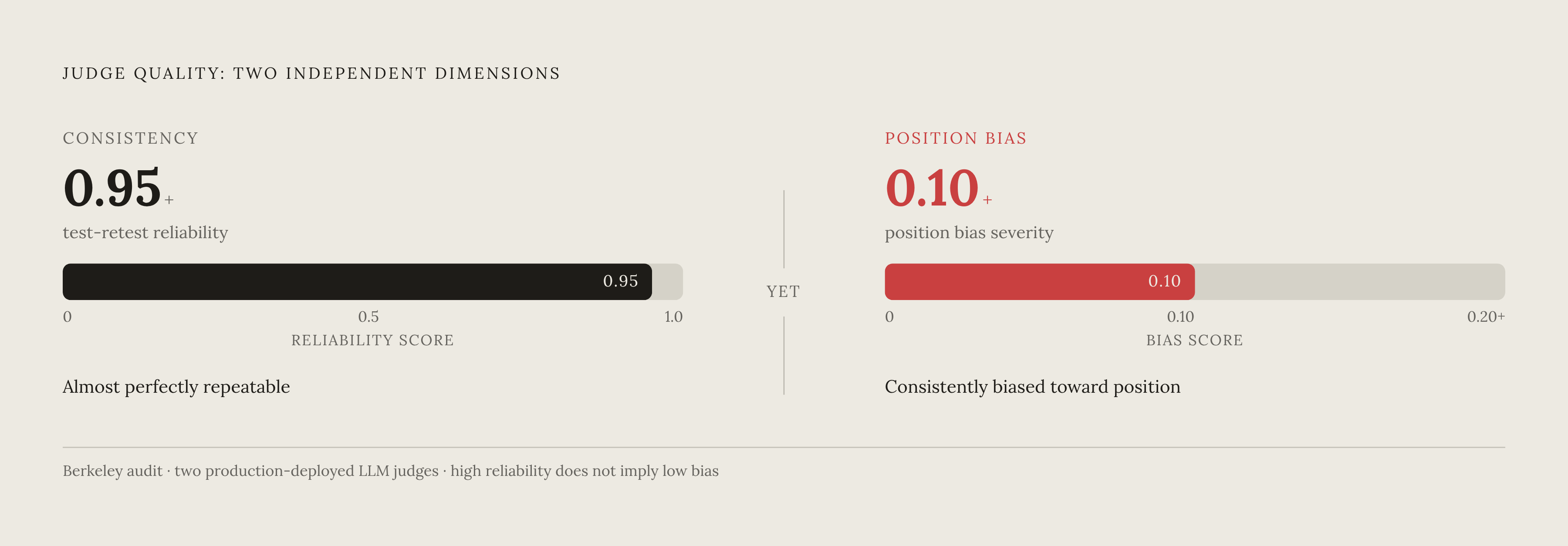
The Berkeley audit's "consistency-bias paradox" shows exactly why consistency alone is not enough to call a system fair. Two production-deployed judges in that study scored with test-retest reliability above 0.95, so they gave nearly the same answer every time they reviewed the same comparison, but they also showed severe position bias above 0.10. A judge can be almost perfectly consistent and still consistently apply a biased standard. Reliability tells you the system repeats itself faithfully. It tells you nothing about whether what it repeats is fair.
The bias taxonomy research has built out, position bias, verbosity bias, self-preference bias, bandwagon bias, and the growing list of variants surveys keep adding, removes any excuse for not knowing these risks exist. Running an AI judging system without accounting for them is now a choice someone makes, not an unavoidable cost of using the technology.
That choice starts earlier than most people assume. Research on reinforcement learning from human feedback has shown that reward models trained through standard RLHF can learn to treat longer responses as better ones even when the extra length adds nothing of value. Verbosity preference can get built into a model before it ever sits down to judge anything. Auditing a model for bias before it gets deployed as a judge is a required step, not a nice-to-have.
What transparent design actually requires, in concrete terms: a scoring rubric published before the first round, not adjusted afterward; panels built from independent models rendering separate verdicts rather than models that deliberate and converge; decisions that cite the specific argument being scored rather than a bare number; a path to human review when a verdict is contested; and no financial stake riding on which side wins. The strongest counterargument to all of this is the Berkeley finding that current models show far smaller verbosity bias under a standard pairwise rubric than earlier models did. But the same researchers caution that their result comes from one rubric and one way of measuring length difference, and does not extend automatically to other rubrics or other tasks. Improvement under one tested condition is not certification across all the conditions a real debate tournament will produce, which is the whole reason transparency has to be the standard rather than a periodic audit.
For a debater, this question is not abstract. A verdict that cites what was actually said and scores it against criteria published in advance tells a debater exactly what to work on before the next round. A verdict that offers neither teaches a debater only that they lost, with no way to learn from it and no way to argue that the system got it wrong.
Sources
- Not All Proofs Are Equal: Evaluating LLM Proof Quality Beyond Correctness
- Judging with Many Minds: Do More Perspectives Mean Less Prejudice? On Bias Amplifications and Resistance in Multi-Agent Based LLM-as-Judge
- Reliability without Validity: A Systematic, Large-Scale Evaluation of LLM-as-a-Judge Models Across Agreement, Consistency, and Bias
- AudioJudge: Understanding What Works in Large Audio Model Based Speech Evaluation
- When Complex Evaluation Context Benefits yet Biases ...