Human-AI Agreement Studies in Competitive Debate Judging
Models reward presentational polish but human judges decide debates on substance.
A growing body of empirical research now makes it possible to measure, with real precision, where AI and human debate judges agree and where they split apart. That precision matters because competitive debate is rapidly adopting AI-scored rounds, and until recently, no one could say with any confidence what those scores actually captured. A verdict delivered by a language model used to be a black box: a number, maybe a few lines of feedback, no way to check it against what an experienced human judge would have said about the same round. The studies now available close that gap, at least partially, and they do it with the kind of scale and controls that competitive debate has never had before: head-to-head benchmarks against expert human debaters, blinded multi-rater designs, and direct comparisons between single-model and multi-agent judging setups. For anyone training debaters or relying on AI feedback to improve, the question is no longer whether a model can render a verdict. It's which parts of that verdict track what human judges actually reward, and which parts a debater should treat with suspicion.
AI-human rater agreement in the LREC 2026 study
The most rigorous evidence so far comes from a study presented at the Language Resources and Evaluation Conference, where researchers Umberto Belluzzo, Kobi Hackenburg, Hannah Rose Kirk, Scott A. Hale, and Paul Röttger benchmarked Llama 3.1 Instruct 405B against 20 experienced human debaters across 100 six-turn Oxford-style debates. Each debate was anonymized and scored by five independent human raters across eleven separate quality dimensions, making it the largest and most carefully controlled head-to-head test of its kind.
The results draw a line between two kinds of debate skill: presentational and substantive. The model won just over half its debates (a 51.2% win rate) and ranked 6th out of 21 debaters by mean performance score, a result that is competitive without being dominant. Human raters consistently scored the model higher on presentational dimensions: clarity, confidence, formality. But on substantive dimensions, including convincingness, evidence, and originality, the model scored about even with its human opponents, no better and no worse.
The detail that matters most for anyone trying to understand how these judgments actually get made is which dimensions predicted who won. Winner choice tracked the substantive dimensions, convincingness, issue knowledge, engagingness, far more closely than it tracked the presentational dimensions where the model had its clearest edge. Clarity and formality did not swing outcomes. Human judges, in other words, were not fooled by polish. They rewarded substance when substance was what separated the two sides.
One more result from the same study deserves attention because it shows these debates were not just graded exercises. If a rater judged a side the winner, that rater's stance shifted toward that side, whether the winner was the model or a human debater. The debates moved real opinions, not just scoresheets. That finding says something important about what's at stake in getting the judging criteria right: these are not abstract evaluation exercises, they are exchanges with measurable persuasive force, and the dimensions that decide them are exactly the dimensions any judging system needs to get right.
How the adversarial structure of debate improves judging accuracy
It isn't just the debaters: the format of debate itself produces better judgments than any single source consulted in isolation.
Debate won by a clear margin. On claims about COVID-19 and climate change, debate improved human judgment accuracy and confidence calibration over consultancy by 4 to 10 percentage points, depending on the condition. The gain held even when judges started with strong, often skeptical, prior beliefs about the claims in question: a genuine two-sided debate moved those judges toward more accurate conclusions, something a single advisor arguing one position could not reliably do.
A debater facing a live opponent has to defend every claim against direct challenge, which makes it much harder to get away with a weak or unsupported argument than it would be speaking uncontested. A single advisor, no matter how persuasive, never faces that pressure. Nobody is in the room pointing out the gaps.
This logic has a pedigree that predates the current wave of AI research. A group of AI safety researchers proposed the idea of AI safety via debate back in 2018, arguing that adversarial structure could, in principle, help a judge who lacks the expertise to evaluate a claim directly still arrive at the truth, so long as the two sides are forced to contest each other's weaknesses. Debate only outperforms simply asking the judge directly when there's a genuine information gap between what the debaters know and what the judge knows, a limit their work also flagged. Where no such gap exists, the adversarial setup adds little. The benefit is real but conditional, not automatic.
The systematic biases that reduce AI judge reliability when the margin between debaters is close
AI judging still carries its own distortions, and you need to know what they are now that AI-scored rounds are becoming common. Verbosity bias, self-enhancement bias, and position bias appear consistently across the evaluation literature.
Verbosity bias is straightforward and corrosive: models reward longer answers independent of whether the extra length adds argumentative depth. For a debater, that creates a bad incentive, padding a case instead of sharpening it, because a model judge may reward the padding. Self-enhancement bias, sometimes called self-preference bias, inflates scores for text that comes from the same model family as the judge itself, and it matters more now that AI debaters and AI judges increasingly share underlying architecture. Position bias affects the order in which arguments are presented and can, on its own, flip the declared winner in a meaningful share of close comparisons.
That last point carries the most weight for competitive debate specifically. The rounds where judging quality matters most are the close ones, where two debaters are genuinely well matched and a human judge's contextual sense of who edged it out is doing real work. Those are exactly the rounds where position bias, verbosity bias, and self-enhancement bias have the most room to distort a verdict, because there's no large quality gap to override them. If you run the comparison with both argument orders and average the results, you can address position bias directly. But it doubles the computational cost of judging, and it's rarely something a live competitive round can accommodate in real time.
How multi-agent judging panels approach human-level agreement
The fix for single-judge bias turns out not to be a better single judge. It's a panel. Moving from one AI judge to a group of them, whether through structured debate among the judges themselves, parallel independent scoring, or some other aggregation method, substantially reduces the bias-driven errors that plague single-model verdicts and pulls AI judgments much closer to what a human majority would decide.
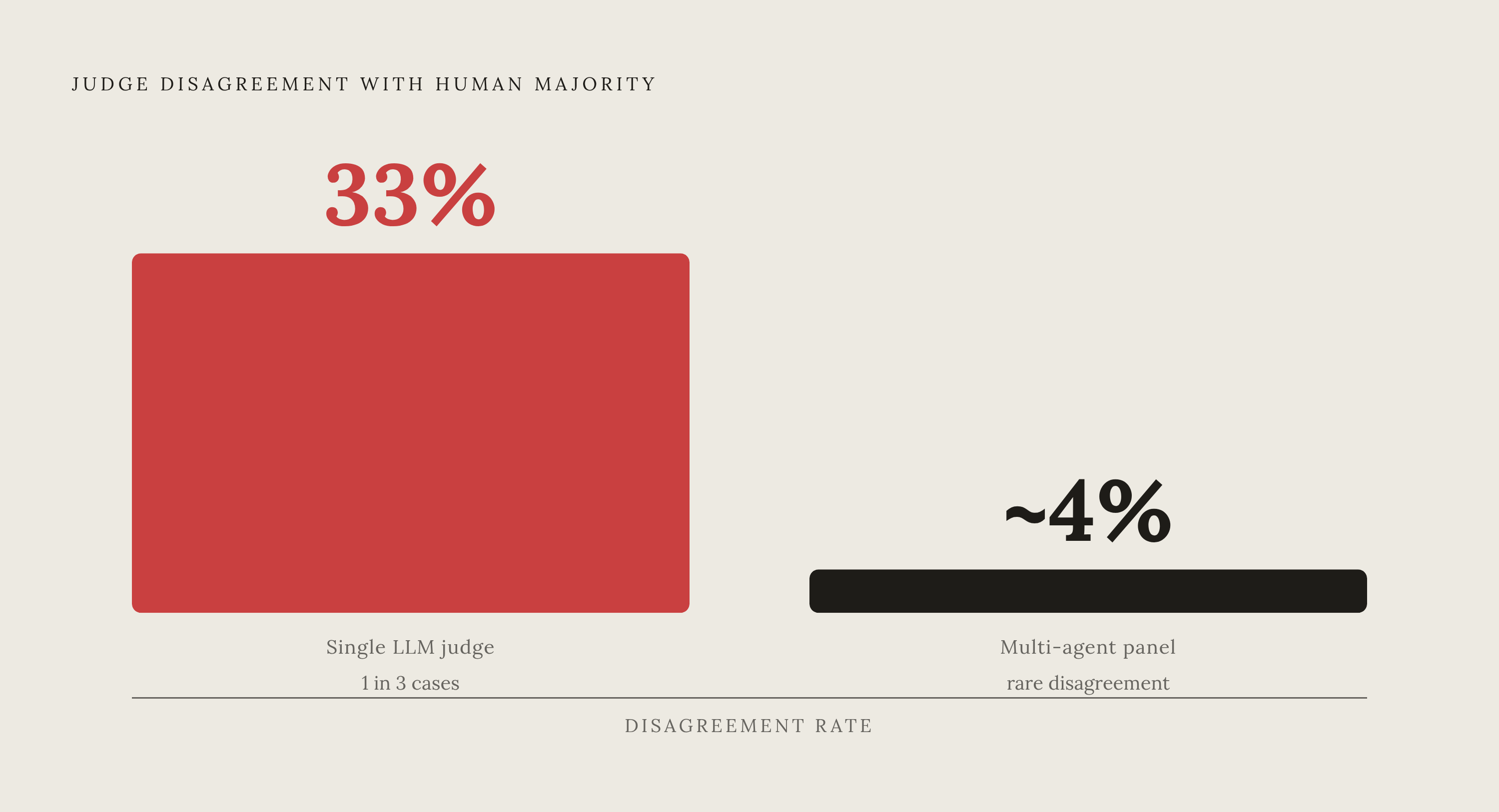
A 2026 analysis by Yu surveyed several of these multi-agent judging frameworks, including ChatEval, DEBATE, CourtEval, and MAJ-EVAL, and found each reported agreement with human judgments and evaluation reliability exceeding that of single-model approaches. One comparison in that body of work found a multi-agent judge panel disagreed with the human-majority vote only a small fraction of the time, while a single LLM judge disagreed with that same human majority in nearly a third of cases. That is a wide gap between a panel and a solo model, and it says the single biggest lever for improving AI-human agreement is more judges.
Why does aggregation work so well? Different models, or different independent runs, tend to carry different biases, not the same bias in the same direction. When their scores get combined, whether through averaging, voting, or structured debate among the judging agents, those individual distortions tend to cancel. Some frameworks build in explicit debate and rebuttal among the judging agents; others just run independent parallel assessments and take a majority vote. Both approaches beat single-model judging, so the core benefit seems to come from aggregating multiple independent judgments, not only from making the judges argue with each other.
The Rahman NeurIPS 2025 study also tested giving AI judges human-like personas rather than leaving them as generic evaluators, alongside panel structure, and found persona-equipped judges reached 78.5% accuracy, outperforming both default AI judges without personas and the human judges in the same study. Calibrating how a judge is set up before it ever sees a round turns out to shift its agreement with human verdicts meaningfully. For a debater trying to decide how much to trust a given AI-scored round, this points to a practical test: a scoring system built on a published, multi-model rubric set up before the round, rather than a single model asked to render a verdict after the fact, is the one worth trusting on a close decision.
What AI judges capture in a live spoken round
Putting the laboratory findings together produces a clear map. AI judging tracks structure and presentation reliably. It is far less dependable on the higher-order skills, rebuttal, counterargument, real-time responsiveness, that experienced human judges weight most heavily when deciding a winner.
The LREC 2026 study shows the dimensions most predictive of human winner choice, convincingness, issue knowledge, engagingness, were exactly the dimensions where the AI model scored at par with human debaters. There's no scoring advantage on the dimensions that are hardest to evaluate and that matter most.
A separate study published in Language Learning & Technology (2026, Vol. 30, Issue 1) adds a parallel finding, this time from the classroom rather than the competitive circuit. English-language learners rated AI feedback as most useful for refining speeches, locating evidence, and developing arguments, but least useful for practicing oral delivery itself. The gap between what AI can assess in written or structural form and what it can assess in live spoken performance appears consistently across two very different research settings, a durable feature of how these systems work.
For a debater reading an AI decision, this translates into a specific reading strategy. A high score on clarity and structure paired with a lower score on convincingness and engagingness identifies exactly where more work is needed. That gap is also precisely the kind of thing a live opponent and a real-time verdict can expose, in a way that a static, written piece of feedback cannot.
What makes an AI judging decision trustworthy and appealing
No single model can hold trustworthy AI judging on its own. It's a property of how the whole judging system is built: published scoring criteria, citations of the actual arguments weighed, multiple models working in aggregate, and a working route to human review. Those four features, taken together, separate a verdict worth learning from a number with no accountability behind it.
Scoring criteria need to be published before the round starts, not reconstructed afterward to justify whatever score the model already produced. The agreement research shows AI judges can track rubric dimensions with real consistency, but only when those dimensions are fixed in advance; building the rubric after the fact is exactly the kind of opacity that makes a verdict impossible to appeal.
Citation of what was actually said in the round matters for a similar reason: verbosity bias and position bias can only be checked against a decision that quotes the specific arguments it weighed. A verdict with no textual grounding gives a debater nothing to argue against.
Multi-model panels are a requirement, not a nice-to-have. The gap between panel agreement and single-model agreement found in Yu's 2026 analysis, combined with the accuracy gains from persona-calibrated judges in the Rahman NeurIPS 2025 study, makes a strong case that aggregated, diverse judging is what close rounds need, not an optional upgrade.
Finally, a human review route has to exist. AI and human judgment pull apart most on the highest-order skills, rebuttal and in-round responsiveness especially, so if a system has no path to human appeal, it asks debaters to accept exactly the verdicts least likely to be reliable.
How AI-human agreement patterns should change debater practice
Knowing where AI and human judges agree should change how a debater actually uses AI-scored rounds, not just how much they trust them. The agreement data points toward a specific division of labor: lean on AI feedback for structure, evidence, and clarity, since those are the dimensions it tracks well, use it to flag convincingness and rebuttal gaps it can identify but can't fully score on its own, and treat live rounds against real opponents, judged by real people, as the test that nothing else replaces.
AI-scored rounds earn their value as practice: high-frequency and low-friction. A debater can run far more of them than live judged rounds, and the agreement research shows they reliably surface structural and presentational weaknesses that can be fixed between sessions.
But the skills where AI judging agrees least with human judgment, rebuttal, in-round responsiveness, engagingness, are also the skills that only show up under pressure from an opponent who is actually trying to beat you. No written feedback loop, however well-built, can substitute for that pressure.
The practice habit the research actually supports has three parts. Use AI-scored rounds to build volume and catch structural problems early. Use live one-on-one rounds, judged and scored, to build the higher-order skills the research shows AI judging still misses. And treat every decision, AI or human, as a document to study closely. That's a more demanding standard than most debaters held themselves to a decade ago, and it's the standard this research now makes possible to meet.